

Timeline Contents
Video: “Native American Governments” PBS, November 24, 2021. https://www.pbs.org/video/native-american-governments-tj1tfi/
Pre-colonial Native American self-governance
8000 BCE- 1492
"Map of Early Indian Tribes, Culture Areas, and Linguistic Stocks”
Prior to the arrival of European colonists in 1492, Native American tribes across the continent had their own forms of government.
The Haudenosaunee [hoh DEE noh SHOH nee] Confederacy (named “Iroquois” [EAR uh KWOY] by the colonials) created their own Constitution, also known as the “Great Law of Peace,” to ensure each nation within the Confederacy would maintain its own leadership but that common causes would be decided by a Grand Council of Chiefs.
The Pueblo [PWEB loh] nation was ruled by a single leader who had a group of advisors similar to today’s presidential cabinet.
The Muscogee [muh SKOH gee] nation, also known as the Creek [KREEK], had a well-established judicial system for punishing criminals. Once people served their punishments, they were allowed back into the community.
By 1898, many of the remaining tribal governments ended when Congress passed an act to break up tribal lands and governments.
These early systems of government can later be found in elements of the U.S. system of government.
Sources: Field Museum and PBS (1), and PBS (2)
Related Inquiry Packs:

Doctrine of Discovery
1493
When European explorers arrived in the Americas, they discovered that Native Americans lived there. The Pope (leader of the Catholic Church) issued an order that said that Christian explorers had the right to claim and take the resources from any lands not inhabited by Christians. This included lands where Native Americans lived. This order was known as the “Doctrine of Discovery.”
Europeans believed that this doctrine allowed them to take the land of native peoples – usually through threats of brutal violence. Long term, it led to colonists’ belief that Native American tribes were not sovereign nations that could govern themselves.
Source: The Gilder Lehrman Institute of American History
Related Inquiry Pack: Experiences of Multiculturalism in the United States

Haudenosaunee shared ideas with political leaders
1649-1787
Leaders of the Haudenosaunee [hoh DEE noh SHOH nee] Confederacy (named “Iroquois” by the colonials) had a lot of influence on political leaders.
In the late 1600s, Kandiaronk served as a political leader and diplomat for the Wendat nation. He negotiated with and debated European leaders and is believed to have influenced their ideas on religion, property rights, the legal system, and sovereignty.
The Haudenosaunee Confederacy was also a model for the federal system of government of the United States. In 1754, Haudenosaunee leaders attended the Albany Congress. Benjamin Franklin incorporated ideas from the Haudenosaunee Confederacy into the Albany Plan of Union. He drafted this to try to unite the colonies against foreign powers. In 1776, Haudenosaunee representatives met with the Continental Congress at what is now Independence Hall in Philadelphia. In 1785, Thomas Jefferson, James Madison, and James Monroe visited the Haudenosaunee to study their confederation. The Framers of the Constitution incorporated ideas shared by the Haudenosaunee into the United States Constitution in 1787.
Sources: Michigan Live and United States Senate
Related Inquiry Pack:
![Mcconnell Map Co, and James McConnell. McConnell's historical maps of the United States. [Chicago, Ill.: McConnell Map Co, 1919] Map. https://www.loc.gov/item/2009581130/](https://legaltimelines.org/wp-content/media/2024/09/iiif-service_gmd_gmd370m_g3701m_g3701sm_gct00482_cs000013-full-pct_25-0-default.jpg.webp "iiif-service_gmd_gmd370m_g3701m_g3701sm_gct00482_cs000013-full-pct_25-0-default.jpg")
French and Indian War
1754-1763
The French and Indian War began in 1754. On one side the war was fought between the British and American colonists who were supported by the Haudenosaunee [hoh DEE noh SHOH nee] Iroquois Confederacy. On the other side were the French and several Native American tribes. Both the French and the British were trying to claim more territory. This caused the conflict that lead to the war. Many historians consider this an extension of the Seven Years’ War the British and French were fighting in Europe at the same time.
After almost nine years of fighting in America, the British were victorious. In 1763, the Treaty of Paris was signed. It gave the British control of Canada and most territory east of the Mississippi.
Source: Oneida Nation
![Melchers, Gari, Artist, and Publisher Detroit Publishing Co. Conspiracy of Pontiac. Michigan Detroit United States, ca. 1921. [C] Photograph. https://www.loc.gov/item/2016817240/](https://legaltimelines.org/wp-content/media/2024/09/service-pnp-det-4a20000-4a26000-4a26300-4a26367v.jpg.webp "service-pnp-det-4a20000-4a26000-4a26300-4a26367v.jpg")
Pontiac’s Rebellion
1763-1765
Pontiac’s Rebellion, also known as Pontiac’s War or Pontiac’s Uprising, was an effort to resist colonization unlike any before efforts. The rebellion involved many Indigenous nations pushing back against British rule over North America and disrespect of Native sovereignty. It was led by Obwandiyag (also known as Pontiac), an Ottawa [ah DAH weh] war chief.
It was triggered by settlers moving onto their land and forcing them to follow Britain’s policies. The loose confederacy of Indigenous Nations attacked British forts and settlements killing hundreds of civilians.
The Indigenous Nations wanted to defend their lands and preserve their sovereignty and traditional ways of life. The revolt started in the Great Lakes region but spread widely. Partially in response to this rebellion, the British passed the Proclamation of 1763. This restricted settlers to land east of the Appalachian Mountains. After two years of intense fighting, the rebellion ended in a stalemate, meaning neither side truly won. At the end of the war, the British were forced to recognize Indigenous sovereignty and reconsider their policy toward Native Americans.
Source: The George Washington Presidential Library
Related Inquiry Pack:
![Kitchin, Thomas, -1784. A new map of the British Dominions in North America; with the limits of the governments annexed thereto by the late Treaty of Peace, and settled by Proclamation, October 7th. [London, 1763] Map. https://www.loc.gov/item/75696331/](https://legaltimelines.org/wp-content/media/2024/09/iiif-service_gmd_gmd3_g3300_g3300_ar010300-full-pct_25-0-default.jpg.webp "iiif-service_gmd_gmd3_g3300_g3300_ar010300-full-pct_25-0-default.jpg")
Proclamation Line of 1763
1763
After the French and Indian War and during Pontiac’s Rebellion, the British government became concerned about the westward expansion of settlers. To separate colonists and Native American tribes, the British government passed the Proclamation of 1763.
The Proclamation established a “Proclamation line” or boundary at the Appalachian Mountains. It forbid colonists from settling on lands west of the line won from the French following the French and Indian War.
The Proclamation also forbid governors from transferring Native American lands to private companies or individuals unless the land was previously acquired by Great Britain through an official treaty.
The British government told colonists that the Proclamation Line was established for their protection. But, many colonists interpreted it as a pro-Indian measure because the British government had formally acknowledged that Native Americans had certain land rights. The Proclamation caused widespread frustration among the colonists.
Source:
![United States Continental Congress, David C Claypoole, and Continental Congress Broadside Collection. The committee, consisting of Mr. Duane, Mr. Peters, Mr. Carrol i.e. Carroll, Mr. Hawkins and Mr. Lee, to whom were referred a report on Indian affairs, read in Congress on the 21st of April last, a letter from General Schuyler ... with messages to and from certain hostile Indians on the subject of peace ... submit the following detail of facts and resolutions. [Philadelphia: Printed by David C. Claypoole, 1783] Online Text. https://www.loc.gov/item/90898080/](https://legaltimelines.org/wp-content/media/2024/02/master-rbc-bdsdcc-08801-0001.jpg.webp "master-rbc-bdsdcc-08801-0001.jpg")
Committee on Indian Affairs
1775-1824
First headed by Benjamin Franklin, the Committee on Indian Affairs oversaw trade and treaty relations between the British colonies and Native American tribes. Ideas from the Committee would later influence the Bureau of Indian Affairs, which was established by Secretary of War John C. Calhoun in 1824.
Related Inquiry Pack:

Treaties between Native Americans and federal government
1778-1871
Between 1778 and 1871, Native American tribes and the federal government signed hundreds of treaties with one another. Nearly 400 of which were formally ratified by the Senate. The U.S. Constitution (Art. II, Sec. 2, Cl. 2) states that these treaties must be made between the tribes and the executive branch, with the advice and consent of the Senate. This has been interpreted to mean the Senate must ratify a treaty by a 2/3 vote.
These treaties put in writing the duties and responsibilities that the federal government owed to a particular tribe. Treaties include agreements about issues such as guarantees of peace, land boundaries, and hunting and fishing rights.
Source: Library of Congress
Related Inquiry Pack:
![United States Constitutional Convention Creator. Constitution of the United States. [Place of Publication Not Identified: Publisher Not Identified, -09-17, 1787] Pdf. https://www.loc.gov/item/2021667573/](https://legaltimelines.org/wp-content/media/2024/02/iiif-service_gdc_gdcwdl_wd_l__02_70_8_wdl_02708_00303_2003_002_pr-full-pct_100-0-default.jpg.webp "iiif-service_gdc_gdcwdl_wd_l__02_70_8_wdl_02708_00303_2003_002_pr-full-pct_100-0-default.jpg")
United States Constitution Article 1, Section 8
September 17, 1787
Article 1, Section 8 of the United States Constitution granted the U.S. Congress the power to “regulate commerce with foreign nations, and among the several states, and with the Indian tribes.”
This enumerated power was used alongside the treaty and war powers of the federal government to imply or suggest that Congress has the ability to enact many laws impacting Native Americans. This included the Indian Removal Act.
Sources: Department of State and National Library of Medicine
Related Inquiry Pack:
"Forced into Federal Boarding Schools as Children, Native Americans Confront the Past | Retro Report." YouTube, uploaded by RETRO REPORT, 11 May 2023, https://www.youtube.com/watch?v=FzZsKzxbszk.
Native American Boarding Schools
1819-1969
Between 1819 and 1969, the United States government operated or supported 408 boarding schools for Native American children across the country. A boarding school is a school where students live at their school, away from their families. After 1871, Congress passed laws to force Indian parents to send their children to school. The laws also authorized the Secretary of the Interior to issue rules and regulations to “secure the enrollment and regular attendance of eligible Indian children who are wards of the Government in schools maintained for their benefit by the United States or in public schools.”*
Children as young as five years old were taken away from their homes and sent to boarding schools. These children were not allowed to practice their religion, speak their native language, or wear traditional clothing and hairstyles in these schools. They often faced severe consequences if they tried to do so. Harsh conditions in boarding schools accounted for the deaths of more than 500 Native American children during this time. Many deaths were covered up by the government and parents were left in the dark about what happened to their children. A 2022 Bureau of Indian Affairs Report confirmed that “the United States directly targeted American Indian, Alaska Native, and Native Hawaiian children in the pursuit of a policy of cultural assimilation that coincided with Indian territorial dispossession.”
Source: Bureau of Indian Affairs, U.S. Department of Interior report and Retro Report
*quote within this report – citation Act of February 14, 1920, Ch. 75, § 1, 41 Stat. 410, codified as 25 U.S.C. § 282 (2020)
Related Inquiry Packs:

Johnson v. McIntosh
February 28, 1823
In the Johnson v. McIntosh decision, the Court cited the “doctrine of discovery” to support the U.S. government ignoring Native American land titles and claiming Native American-held land for themselves.
In the eyes of the U.S. government, this decision laid the legal groundwork needed for removal of Native Americans from their land. The decision also established that the federal government had the sole right of negotiation with the Native American nations.
This meant that the Indians themselves had no right to sell property to any non-Indian persons or governments other than the United States.
Source: Oyez
Related Inquiry Pack:

Indian Removal Act signed into law by Pres. Jackson
May 28, 1830
As more people moved to the United States, there were more people in search of land. President Andrew Jackson convinced Congress to pass a bill allowing him to grant Native Americans land west of the Mississippi River in exchange for giving up their current tribal lands within state borders. President Jackson signed the bill called the Indian Removal Act into law on May 28, 1830.
This law meant that Native American tribes had to agree to give up their homelands. The Removal Act authorized President Jackson to enter into treaties that would force dozens of tribal nations to lands west of the Mississippi. The Act also authorized the President to use the military to remove the tribes by force.
The removal act led to the forced removal of many Native Americans, without aid and against their will. They were made to leave their lands against their will and without aid or support. This was called the “Trail of Tears.”
Source: Library of Congress
Related Inquiry Pack:
![Historical caricature of the Cherokee nation. [Place not identified: Publisher not identified] Photograph. Retrieved from the Library of Congress, <www.loc.gov/item/2008661841/>.](https://legaltimelines.org/wp-content/media/2024/02/service-pnp-cph-3b30000-3b36000-3b36100-3b36104r.jpg.webp "service-pnp-cph-3b30000-3b36000-3b36100-3b36104r.jpg")
Cherokee Nation v. Georgia
March 18, 1831
The Cherokee Nation hoped to prevent their removal by challenging Georgia laws that declared that tribal territory could be divided up and distributed to white citizens in the state of Georgia. The Cherokee Nation believed the laws violated their rights. They said that the treaties they had already signed with the federal government promised their tribe sovereignty and federal protection.
At first, the Supreme Court refused to rule on that issue. In Cherokee Nation v. Georgia (1831), the Court instead ruled that the Court did not have original jurisdiction. This meant that the Cherokee Nation could not bring their case to the Supreme Court because it was what the Court called a “domestic dependent nation.” The Court said that the Constitution allowed the Supreme Court to hear cases about treaties with “foreign nations” not “Indian nations.” Chief Justice John Marshall stated, “[T]heir [Indian nations] relation to the United States resembles that of a ward to its guardian.”
The Supreme Court did rule in favor of the Cherokee Nation the following year in Worcester v. Georgia (1832). However, the Court's decision did little to prevent the removal of the Cherokee Nation.
Sources: Oregon.gov, The West

Trail of Tears
1831-1850
President Andrew Jackson used the Indian Removal Act to force Native Americans off their land. Many tribes resisted relocation. In the winter of 1831, members of the Choctaw [CHOCK taw] Nation became the first to endure the forced march to new lands. Many died, prompting a Choctaw leader to describe it as a “trail of tears and death.”*
Over the next two decades, around 100,000 Native Americans were removed from their homelands to other lands, usually in Oklahoma, Wisconsin, and other states to the west of the Mississippi River. Because many thousands of Native people died during this time, the removal of the Cherokee [CHEH roh kee] Nation in 1838 was called the “Cherokee Trail of Tears” and the removal of the Potawatomi [pah tah WAH toh mee] bands from the western Great Lakes was called the “Potawatomi Trail of Death.”
Source: *History.com
Related Inquiry Pack:

Worcester v. Georgia: Native American tribes found sovereign, but Pres. Jackson doesn’t enforce
March 3, 1832
In the 1832 case of Worcester v. Georgia the U.S. Supreme Court recognized the sovereignty of the Cherokee Nation. The case was started with the arrest of Samuel Worcester, a non-Native American who defended the Cherokees’ rights. Worcester and his supporters came up with a plan to stop settlers from pushing Cherokees off their land. They protested the Georgia law by refusing to move from Native American territory. The governor of Georgia ordered the military to arrest them. They were found guilty of breaking the Georgia law and were sentenced to four years of hard labor. Worcester then appealed the case to the Supreme Court. He argued that Georgia did not have the power to create laws that controlled the Cherokees.
The majority opinion was written by Chief Justice John Marshall. He pointed to treaties that showed that Native American communities were separate from the states. Chief Justice Marshall wrote that Native Americans “had always been considered as distinct, independent political communities.” This statement declared that Native American tribes had sovereignty and were not subject to the laws of states. The Court stated that treaties between the United States and tribal nations were superior to state laws, which had “no force in Indian country.”
Even though the Supreme Court recognized the sovereignty of the Cherokees, the state of Georgia asked the federal government to push the Cherokees off their territory.
At first, President Andrew Jackson ignored the Supreme Court’s decision. This action, however, threatened to make the conflict between the federal government and the state of Georgia worse. Ultimately, there was a compromise. This compromise resulted in the law that led to Worcester’s arrest. Jackson, however, continued to focus his efforts on Indian removal.
Sources: Worcester v. Georgia: Case Pack for Middle School and *History.com
Related Inquiry Pack:
![Cherokee Nation, Oklahoma, Daniel H Ross, and J. A Scales. Constitution and laws of the Cherokee Nation. composeds by Boudinot, W. P [St. Louis, R. & T. A. Ennis, printers, 1875] Pdf. https://www.loc.gov/item/28014177/.](https://legaltimelines.org/wp-content/media/2024/02/iiif-service_ll_llscd_28014177_00020000-full-pct_100-0-default.jpg.webp "iiif-service_ll_llscd_28014177_00020000-full-pct_100-0-default.jpg")
Constitutions of Cherokee, Choctaw, Chickasaw, Creek, and Seminole tribes
1830 - 1940
As a consequence of the Indian Removal Act, many tribal nations such as the Cherokee [CHEH roh kee], Choctaw [CHOCK taw], Chickasaw [CHIK uh saw], Creek [KREEK], and Seminole [SEH mih nohl] were forced to leave their land in the Southeast and relocate to the Indian Territory. These tribal nations, often called the Five Tribes, created constitutions to protect tribal sovereignty, organize tribal government, and define tribal membership.
Sources: Library of Congress and Beth Redbird
Related Inquiry Pack:


Battle of Little Bighorn
June 25-26, 1876
In 1868, the U.S. government signed a treaty with tribes in what is now several states, including South Dakota. The treaty required that these tribes settle into reservations. Reservations were specific areas reserved for the tribes, Reservations were created by the federal government to provide a space for tribes to live once they were forced off of their own lands. The U.S. Army never complied with the terms of the treaty, which required the Army to keep non-Native American settlers out of the reservations. In 1875, gold was discovered in the area. U.S. Army Lt. Col. George Armstrong Custer led an expedition into the Black Hills in order to publicize the discovery of gold. The Lakota fought against Custer’s invasion. Custer’s forces were quickly overwhelmed at the Battle of Little Bighorn. This became known as “Custer’s Last Stand.” The Army’s loss at the Battle of Little Bighorn led to the U.S. government increasing efforts to force native people in the area onto reservations. Within five years, most were confined to reservations.
Sources: National Park Service and History.com
Related Inquiry Packs:
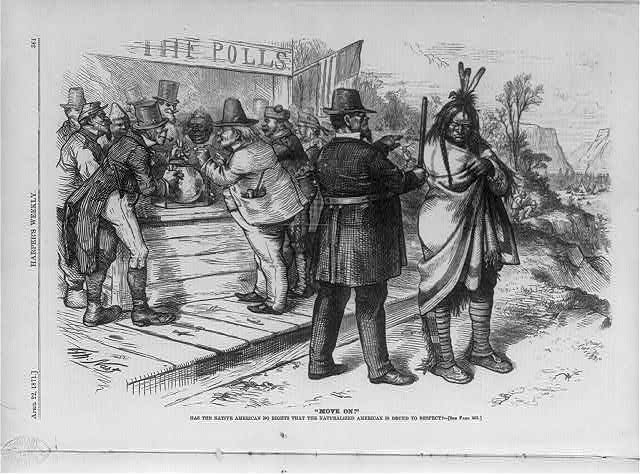
Elk v. Wilkins: Native Americans denied the right to vote
April 28, 1884
John Elk was a Native American who was born on an Indian reservation but later moved away. He officially gave up his tribal affiliation and claimed birthright citizenship of the United States according to the 14th Amendment’s Citizenship Clause. He moved from tribal lands to Omaha and paid his taxes. When he tried to vote, he was denied. In this Supreme Court ruling on his case, Elk was denied citizenship and thus the right to vote. The Court said that the 14th Amendment's Citizenship Clause did not apply to Native Americans. It ruled that though Elk was born inside the “territorial limits of the United States,” he was not an American citizen without an Act of Congress conferring citizenship upon him.
Source: National Constitution Center

Dawes Act
February 8, 1887
This act allowed the federal government to take away Indian reservations and “allot” (divide up and give) the lands back to individual tribal citizens. The Act was designed to break up tribal lands and weaken Native Americans’ tribal connections. It was another attempt by the U.S. government to assimilate Native Americans. The government wanted Native Americans to give up their collective ownership and use of land, and encourage individual ownership of land.
As a result of this act, any Native American who accepted the division of their lands was allowed to become a U.S. citizen, thereby also being granted the right to vote.
The act resulted in tribes across the country losing more than 62% of their land to non-natives.
Source: National Park Service
Related Inquiry Packs:

Wounded Knee Massacre
December 29, 1890
The Wounded Knee Massacre was one of the last military actions against Native Americans of the Northern Plains. Leading up to the massacre, the U.S. government banned a religion known as the Ghost Dance on a South Dakota reservation. To stop a crackdown against the Ghost Dance, U.S. soldiers arrested hundreds of members of the Lakota [lah KOH tah] tribe and held them in a camp near Wounded Knee Creek.
The next day, the U.S. soldiers tried to take weapons from the Lakota. A gun went off accidentally, and soldiers opened fire, killing hundreds of unarmed Lakota men, women, and children.
The U.S. government investigated what it referred to as the “Battle of Wounded Knee.” The investigation found that the commander’s actions were reasonable and restored him to his job.
In 1990, the U.S. Congress passed a joint resolution honoring the one-hundredth anniversary of the Wounded Knee Massacre and expressing the regret of the U.S. government. The massacre site has become a place of remembrance for Native Americans. Decades later, during the Civil Rights Movement, Wounded Knee would become a rallying cry in protests for Native American rights.
Source: Library of Congress
Related Inquiry Packs:

Committee of One Hundred on Indian Affairs (formally – the Advisory Council on Indian Affairs)
December 13, 1923
The Committee of One Hundred consisted of 100 Indian and non-Indian scholars, activists, and policy specialists who advised the federal government on important issues facing Native American people. It was organized by Secretary of the Interior, Herbert Work, to propose reforms in Indian policy. In 1923, President Calvin Coolidge met with the Committee of One Hundred at the White House. The committee called for reforms including improving Indian education, removing bans on religious ceremonies, and securing Indian mineral rights on their lands. Although the meeting did not result in immediate reforms, it may have influenced President Coolidge to sign the Indian Citizenship Act in 1924 and set the stage for policy during the 1930s and after.
Source: White House History
Related Inquiry Pack:

Indian Citizenship Act
June 2, 1924
The Indian Citizenship Act granted all Native Americans U.S. citizenship and the right to vote regardless of tribal affiliation. At the time of this act’s signing, almost two-thirds of Native Americans were already citizens of the United States through other means, including through the Dawes Act.
Source: Library of Congress

Indian Reorganization Act (IRA)
June 18, 1934
The Indian Reorganization Act (IRA), sometimes called the “Indian New Deal” is considered a turning point in United States-tribal relations. The IRA focused on Indian self-government and encouraged tribes to create tribal governments structured like the federal three-branch system, tribal constitutions (subject to the Secretary of the Interior’s approval), and corporate charters to manage tribal economic operations.
The law also included sections allowing the Secretary of the Interior to acquire land held in trust for Native people and tribal nations as a remedy for the lands lost during allotment. It also gave the Secretary of the Interior the authority to establish new reservations. The IRA was signed into law by President Franklin D. Roosevelt.
Source: Library of Congress and 25 U.S.C. § 5101 et seq.
Related Inquiry Pack:

United States v. Santa Fe Pacific Railroad
December 8, 1941
In a unanimous decision, the Supreme Court declared that the Hualapai [wal lah pie] people had rights to their lands even without clear recognition of land title by a treaty. It ruled that Native nations hold “‘aboriginal title’ to their lands” because they have lived on those lands since before the colonists came to the Americas. This decision is considered a landmark case because it affirmed Indian land rights.
Source: The Rediscovery of America by Ned Blackhawk p. 405
Related Inquiry Pack:

National Congress of American Indians Founded
November 17, 1944
The National Congress of American Indians was founded in 1944, when close to 80 delegates from 50 tribes and associations came together in Denver, Colorado. It was founded in response to threats of termination, and assimilation policies the U.S. government forced upon tribal governments that contradicted (went against) their treaty rights and status as sovereign nations.
The founding members called for unity and cooperation among tribal governments and people for the security and protection of treaty and sovereign rights. They also committed to the improvement of the quality of life of Native people.
Source: NCAI

Indian Claims Commission Act
May 21, 1946
After years of effort by Native Americans to resolve long-standing land claim cases fairly, Congress passed the Indian Claims Commission Act. The act established a temporary commission to decide land claim cases of American Indians who believed the federal government had treated them unjustly through treaty violations, taking their land, and other grievances. Congress quietly intended the Commission to conclude all Indian and tribal claims as a first step toward terminating Indian affairs. The few tribes who won claims did not receive any land back, instead receiving a small percentage of the value of the land taken from them.
Source: The Capitol Visitors’ Center

Federal policy of termination announced
August 1, 1953
The federal policy of termination called for the end of tribes’ status as separate government entities. It ended federal aid and services to tribes in certain areas, and led to the selling off of reservation lands. In many cases, termination also meant giving states jurisdiction over criminal and civil court cases taking place on reservations. Before this the federal government had jurisdiction, not the state.
The federal government’s stated goal for this policy was to assimilate Native Americans into U.S. society. In reality, the policy was just another way that the U.S. government took away tribes’ sovereignty, culture, and lands.
From 1953 until the early 1960s, Congress terminated over 100 tribal nations. Termination led to the the government confiscating (taking) and selling over three million acres of tribal lands and the destruction of tribal governments. Many tribal nations never recovered. In 1973, Congress passed the first restoration act. This restored the federal responsibility to the Menominee [me-NOH-muh-nee] Tribe of Wisconsin. Over the next several decades, Congress restored dozens of terminated tribes, but not all.
Sources: National Park Service and National Archives

Indian Civil Rights Act (ICRA)
April 11, 1968
The Indian Civil Rights Act (ICRA) forbids tribal governments from creating or enforcing laws that violate certain individual rights that are promised in the United States. Like the United States Constitution's Bill of Rights, the ICRA protects freedom of religion and speech, forbids double jeopardy, prevents defendants in criminal cases from self-incrimination and guarantees other rights.
The ICRA was signed into law by President Lyndon B. Johnson.
Sources: 25 U.S.C. § 1301 et seq. and Library of Congress
Related Inquiry Packs:

American Indian Movement (AIM) founded
July 1, 1968
The American Indian Movement (AIM) was created as a grassroots movement for Indigenous rights. AIM was founded in Minneapolis, Minnesota by Native American people. It originally was a movement formed in response to police brutality and racial profiling that occurred in the aftermath of the termination policy as tribes were being disbanded and Native Americans were being pressured to move to cities.
In the 1970s, AIM became a major force in the Native American civil rights movement, conducting some of the highest-profile protests and acts of civil disobedience in American Indian history. Although AIM split in two in 1993, its successors continue its legacy of fighting for Native American rights, holding the United States government responsible for the treaties it has broken and drawing attention to the cause of Indigenous Peoples around the world.
Related Inquiry Packs:

Indian Self-Determination and Education Assistance Act (ISDEAA)
January 4, 1975
The Indian Self-Determination and Education Assistance Act (ISDEAA) gave tribes authority to make contracts with the federal government that would allow self-governance. The ISDEAA was enacted to increase tribal self-determination and self-governance and became, over time, one of the most successful Indian affairs programs in history. The law made it possible for tribes to provide their own governmental services, which were formerly overseen by the U.S. government’s Bureau of Indian Affairs and the Indian Health Service.
The Indian Self-Determination and Education Assistance Act was signed into law by President Gerald Ford.
Sources: 25 U.S.C. § 5301 et seq., Bureau of Indian Affairs, Library of Congress, and CRS Reports
Related Inquiry Packs:
“In the Long Fight to Protect Native American Families, a Law Stands Guard | Retro Report ,” Retro Report, July 13, 2023, https://www.youtube.com/watch?v=Kd5P96Oga9o.
Civil Rights Protests: Poor People’s Campaign 1968, Occupation of Alcatraz 1969-1971, Trail of Broken Treaties, 1972, Trail of Self-Determination, 1976, The Longest Walk, 1978
1968-1978
In the 1950s and 1960s, Black Americans led the Civil Rights Movement. This was a widespread effort to end discrimination and secure equal legal rights for Black Americans and by extension for all people. Native American activists were inspired by the Civil Rights Movement’s success in increasing public awareness and changing federal laws through marches, sit-ins, and acts of civil disobedience. Because Native Americans made up a small minority of the U.S. population, they were easily ignored when they protested United States Indian policies. But Native American activists joined together with groups that shared similar goals and engaged in demonstrations. This allowed them to bring attention to the fight for tribal sovereignty.
The most important issue for the Native American rights movement in the 1960s was the policy of termination. When Native American activists marched to Washington, D.C. from 1968 to 1978, they marched not only for their rights, but for their very existence. Although they borrowed some strategies from the Civil Rights Movement, the fight for Native American rights was a separate issue. While the Civil Rights Movement was a struggle for equality, the Native rights movement was about the right of Native nations to exist as distinct and sovereign nations.
Source: National Park Service
Related Inquiry Packs:
"The 1969 Occupation of Alcatraz Was a Catalyst for Indigenous Activism | Retro Report." YouTube, uploaded by RETRO REPORT, 2 Feb. 2024, https://www.youtube.com/watch?v=QUfVyGj_STw.
Indian Child Welfare Act (ICWA)
November 8, 1978
The Indian Child Welfare Act (ICWA) was passed in 1978. It was passed in response to studies about Indian children that showed 25 to 35 percent of all Native children had been removed from their homes and placed into non-Indian homes. Before the ICWA’s passage, 80% of Native Americans living on reservations had at least one child who was in the foster care system. In large part, these children were taken from their families because of the ignorance and insensitivity of local child welfare organizations who had the power to take the children away.
Congress stated the purpose of ICWA was “to protect the best interests of Indian children and to promote the stability and security of Indian tribes and families.” ICWA established preferences for placing Indian children with their extended family or other tribal families if they were not able to safely stay with their parents. It also required an effort to reunite an Indian child with their family, and put in place protections to ensure that when a Native American birth parent voluntary gives their child up for adoption, it is truly voluntary. ICWA also made tribal courts the preferred courts to hear Indian child welfare cases instead of United States government courts.
Sources: 25 U.S.C. § 1901 et seq., Bureau of Indian Affairs, and Library of Congress

American Indian Religious Freedom Act
August 11, 1978
The American Indian Religious Freedom Act, signed into law by President Jimmy Carter, prevented federal agencies from discriminating against, interfering with, or prosecuting Native people who engaged in traditional ceremonies on federal and tribal lands.
Source: National Library of Medicine
Related Inquiry Pack:

Employment Division, Department of Human Resources of Oregon v. Smith
April 17, 1990
Two Native men who were counselors for a private drug rehabilitation organization were fired for using peyote – a cactus that contains a powerful drug that can cause hallucinations. As members of the Native American Church, the men ingested peyote as part of a religious ceremony. After being fired, the men filed a claim for unemployment compensation. They were denied benefits because the reason for their firing was considered work-related misconduct. The men claimed the denial of benefits violated their First Amendment freedom of religion under the Free Exercise Clause. The Supreme Court found against the men and said, “the Court has never held that an individual's religious beliefs excuse him from compliance with an otherwise valid law prohibiting conduct that government is free to regulate.”
Source: Oyez
Related Inquiry Packs:

Native American Graves Protection and Repatriation Act
November 16, 1990
The Native American Graves Protection and Repatriation Act required federal agencies and museums that receive money from the federal government to give back or transfer certain Native American cultural items from their collections. Before the passage of this act, museums and other federal agencies held important cultural items from Native American history, including items taken from Native American gravesites. These items include human remains (for example, bones), objects used at burial, sacred objects, and other items owned by individuals. The Act provides for the objects to be returned to direct descendants, and to Indian tribes or other Native American organizations.
Source: Bureau of Land Management
Related Inquiry Packs:

Cobell v. Salazar
2009
Cobell v. Salazar was the largest class action lawsuit in U.S. history, with more than 500,000 Native Americans suing the U.S. Department of the Interior and Department of the Treasury. In 1996, the lawsuit was brought by a Blackfoot Indian, Eloise Cobell, on behalf of hundreds of thousands of Native Americans alleging the U.S. government had failed in its duties, mismanaged Indian trust land and money, and failed to pay revenues owed to them.
After 15 years, the case was settled out of court during the Obama Administration. The settlement included that the federal government would pay $3.4 billion to plaintiffs in the suit. The government also agreed to repurchase $2 billion worth of land that was originally sold under the Dawes Act. This land would then be returned to tribes.
Source: ThoughtCo.
Related Inquiry Pack:
Signing the Tribal Law and Order Act, YouTube, uploaded by The Obama White House, Jul 29, 2010, https://www.youtube.com/watch?v=h4K1UYCC0dQ
Tribal Law and Order Act
July 29, 2010
The Tribal Law and Order Act (TLOA) was passed and signed by President Barack Obama to reduce crime on tribal lands, especially crimes such as domestic violence, sexual assault, drug abuse and drug trafficking. The Act provided tribal courts with enhanced sentencing authority, allowing them to order longer sentences and larger fines. TLOA also clarified the jurisdiction of Indian nations and supported the collection and sharing of crime data. Later, in 2013, the Violence Against Women Reauthorization Act ensured that tribal nations could prosecute non-Indians who commit domestic and intimate partner violence in Indian country.
Source: Tribal Justice Institute
Descendant of Sitting Bull speaks at UN about fight against Dakota Access and State Violence, YouTube, uploaded by ienearth, Apr 26, 2017, https://www.youtube.com/watch?v=36NO4EiYb78
Standing Rock Sioux Tribe’s protest against Dakota Access Pipeline
2016-2017
A 1,200-mile-long oil pipeline called the Dakota Access Pipeline (DAPL) was planned to be built between North Dakota and Illinois. Its purpose was to transport large amounts of oil across the country. The Standing Rock Sioux tribe was opposed to the construction of the DAPL. The pipeline would run close to their reservation land and would go through traditional Sioux lands. They believed it violated a treaty guaranteeing them “undisturbed use and occupation” of lands surrounding the proposed pipeline. They also asserted that construction would destroy cultural resources, their water supply, and their way of life. The tribe was worried about the damage the pipeline could cause to the environment.
They organized marches, runs, and horseback rides to call attention to their protest. They ran a successful social media campaign with the hashtag #NoDAPL. They gained worldwide attention and support from other tribes, celebrities, and politicians. At times violence broke out and hundreds of protesters were arrested by police.
The Standing Rock Sioux Tribe’s protest became a global symbol of Indigenous environmental activism. As a likely result of the protests, a federal court ordered the U.S. government to conduct an environmental review of the pipeline but allowed the pipeline to operate during the review. President Barack Obama halted construction on the DALP. However, President Trump reversed this decision during his first term in office. The pipeline was completed and began working in 2017. Many Native Americans and others still celebrate the protests as a model for future activism.
Source: National Museum of the American Indian | Standing Rock protests | Summary, Violence, & Outcome | Britannica
Related Inquiry Packs:

Savanna’s Act
October 10, 2020
Savanna’s Act was originally introduced in 2017 after the abduction and murder of Savanna LaFontaine-Greywind in Fargo, North Dakota. Savanna was a member of the Spirit Lake Tribe. Savanna’s Act makes clear federal, state, tribal and local law enforcement responsibilities in cases of missing or murdered Indian people. It has the goal of increasing communication and coordination between federal, tribal, state, and local law enforcement agencies and improving tribal access to resources and information. Savanna’s Act also requires data collection related to missing and murdered Indian people.
Source: Indian Law Resource Center

Not Invisible Act
October 10, 2020
The Not Invisible Act was intended to “increase intergovernmental coordination to identify and combat violent crime within Indian lands and of Indians.” The Act established a Joint Commission on Reducing Violent Crimes Against Indians which will make recommendations to the Departments of Interior and of Justice about ways to combat disappearances, murder, trafficking, and other violent crimes against Native Americans and Alaska Natives.
Source: Indian Law Resource Center
![Rand Mcnally And Company. Map of the Indian and Oklahoma territories. [S.l, 1892] Map. Retrieved from the Library of Congress, <www.loc.gov/item/98687110/>.](https://legaltimelines.org/wp-content/media/2024/02/map-of-the-indian-and-oklahoma-territories.jpg.webp "map-of-the-indian-and-oklahoma-territories.jpg")
McGirt v. Oklahoma
July 9, 2020
A member of the Muscogee [muh SKOH gee] Creek Nation, Jimcy McGirt, was convicted by the state of Oklahoma of crimes against a child. Under the Indian Major Crimes Act, any crime involving a Native American, or occurring within reservation boundaries, is subject to federal jurisdiction, not state jurisdiction. McGirt argued while the crime in question did not occur on what is today considered a reservation, it did occur within the historical Creek Nation boundaries.
The Supreme Court considered the question: Can a state prosecute an enrolled member of the Creek Tribe for crimes committed within the historical Creek boundaries?
The Supreme Court found for McGirt and ruled that according to an 1856 treaty a significant portion of eastern Oklahoma, including the city of Tulsa, remains reservation land for the Muscogee (Creek [KREEK]) Nation. Therefore it was not within the jurisdiction of the state of Oklahoma to prosecute McGirt. This decision reaffirmed the importance of treaty rights and tribal sovereignty.
Source: Oyez
Related Inquiry Pack:

Deb Haaland confirmed as the first Native American Secretary of the Interior and cabinet member
March 15, 2021
Secretary of the Interior Deb Haaland became the first Native American to serve as secretary of an executive department. She is a member of the Pueblo of Laguna and a 35th-generation New Mexican.
Source: Department of the Interior
Related Inquiry Pack:
"Forced into Federal Boarding Schools as Children, Native Americans Confront the Past | Retro Report," YouTube, uploaded by Retro Report, May 11, 2023, https://www.youtube.com/watch?v=FzZsKzxbszk
Federal Indian Boarding School Initiative
June 22, 2021
The Federal Indian Boarding School Initiative was announced by Secretary of the Interior, Deb Haaland. The initiative ordered an investigation of the loss of human life and lasting consequences of the Federal Indian boarding school system.
Source: Bureau of Indian Affairs
Related Inquiry Pack:
Contemporary legal action and advocacy
2024-
As of 2024, Native Americans continue to fight for their rights, recognition, resources, and sovereignty. Several tribes continue to litigate to protect Native lands against disruptive construction projects. Native people continue to fight for the repatriation of their ancestors’ remains and cultural artifacts. Some Native Americans continue to fight for federal tribal recognition, as well. If you did a news search of Native American law today, what will you find?
Related Inquiry Packs:
